How refillables filled up our feeds
OG creators, late night talk shows, and digital studios led the way to an endless scroll of celebrity challenges
First published on Creatorama ↗
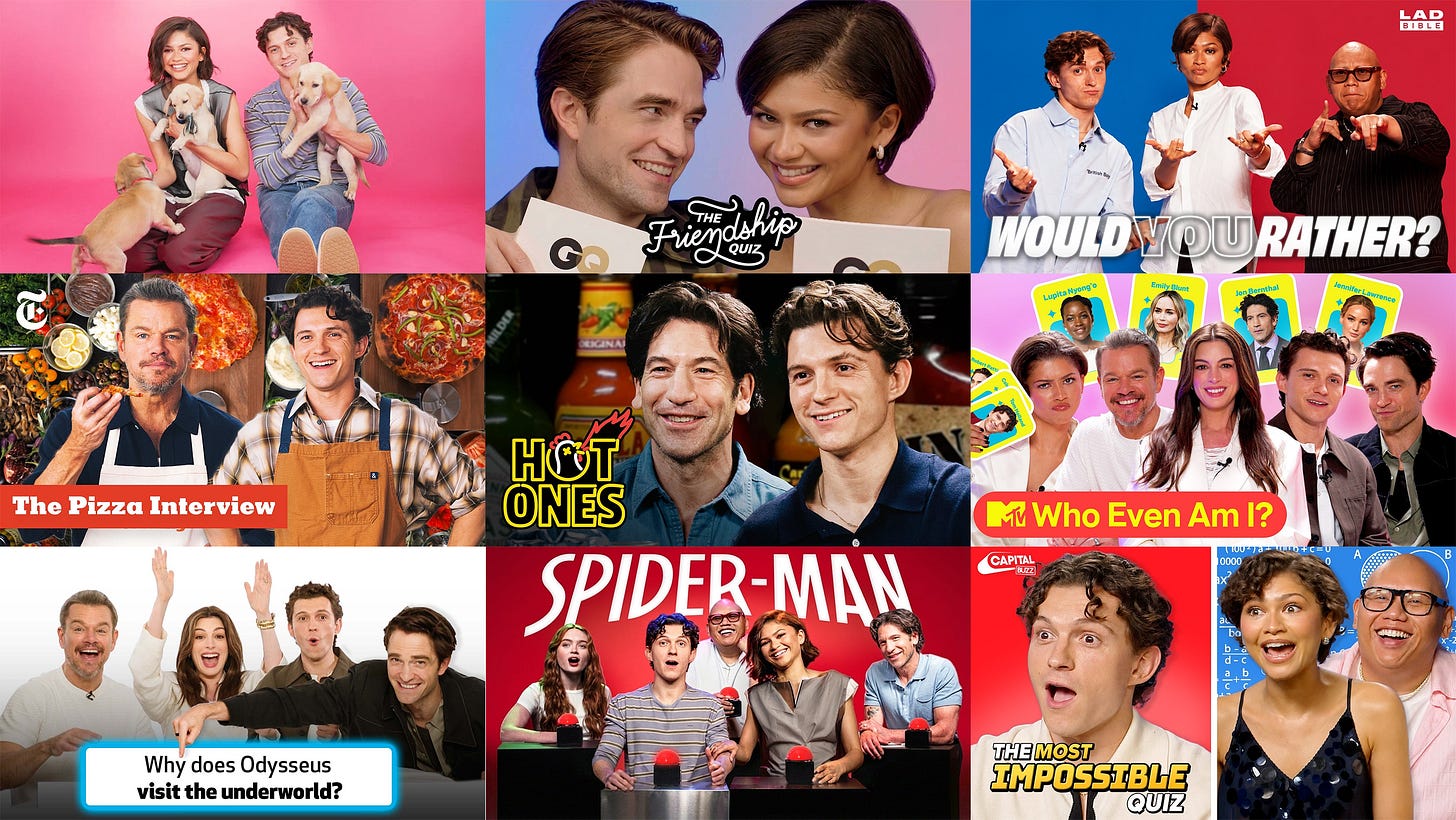
The Guardian has a piece this week on “the Fallon-ification of journalism,” i.e., how the promotion of every movie has turned what used to be a few days of junket interviews for A-list casts into a gauntlet of gimmicky social video formats to run. Jesse Hassenger writes:
Has it really convinced a single person to see The Odyssey? Publicists will doubtless claim that it’s the awareness of the movie, not the specific desire to see it, that these videos aid. Attentive viewers, meanwhile, might study the screen to figure out who looks genuinely fine with it and who looks like they’re considering poisoning themselves or their agents.
Between The Odyssey and Spider-Man, my feed’s full of thumbnails of Tom Holland, Zendaya, Sadie Sink, and Jon Bernthal in everything from trivia games to making pizzas, to the point of supersaturation, but like a lot of things that eventually became annoyingly ubiquitous, this all started from a creative and innovative place.
Over a decade ago, when everyone was trying to figure out how to build audiences on YouTube, one of the main pieces of advice from the YouTube Playbook was to upload frequently. Making viral videos on repeat was hard, so creators were advised to find repeatable formats they could produce consistently. The best creators came up with a loose regular format, committed to a (loose) regular upload time, and did something surprising and entertaining every time—Epic Rap Battles of History, My Drunk Kitchen, Kids React, and Auto-Tune the News were all great examples on the high-concept side, but so were personality-driven videoblogs like Vlogbrothers, Jenna Marbles, and Michelle Phan. Fred Seibert once said to me that great TV was “dependable without being predictable”—a phrase I would think about a lot, as it worked for YouTube, too.
Meanwhile, back on TV, a new generation of late night talk show hosts, like Conan O’Brien, Jimmy Kimmel, and Jimmy Fallon, were thinking about how to make their mark on the medium, and they also had one eye on the Internet, where their audiences were going.
Much of what worked in late night—the monologues, the interviews, the live studio audiences—didn’t translate well to online video, and TV networks blocked sharing much of it anyway, with things like music rights, advertiser and affiliate deals, and personalities’ right to publicity making things more complex. But one part was tailor-made for social video—the recurring bits and segments that Gavin Purcell, then a producer at the Tonight Show, told me they just called “refillables.”
Repeating bits and sketches have been around as long as people have had to write and perform comedy shows, since coming up with good new material, day in and day out, is incredibly hard. Mel Brooks and Carl Reiner had The 2,000 Year Old Man; Johnny Carson had Carnac; Conan had Triumph and In the Year 2000; SNL had Weekend Update, Mr. Robinson’s Neighborhood, What Up with That? and many more. SNL writer Harper Steele explained it this way to Ellen writer Jason Gelles: “If you’re going to work on a daily show, you need to create your own version of [David Letterman’s] Top Ten List: a bucket that you can fill up week after week.”
The first of the late night shows to launch a YouTube channel was Jimmy Kimmel’s, in 2009, after uploads of “F*@#ing Matt Damon” went viral. Refillables like “Mean Tweets” and Kimmel’s annual Halloween Candy Prank became huge recurring hits on YouTube. Gavin and the team at Late Night with Jimmy Fallon, who had already helped Jimmy build a a massive following on Twitter, were definitely watching with interest: in 2013, they launched the YouTube channel that followed Fallon to The Tonight Show, and by 2014 they’d overtaken Jimmy Kimmel on YouTube, with segments like “Lip Sync Battle.” (Conan, meanwhile, was the first to launch a hit format originally on YouTube, “Clueless Gamer,” before it went to TV. )
Some writers were particularly great at these bits, like Diallo Riddle and Bashir Salahuddin, who wrote “Slow Jam the News” and “History of Rap,” or Mike Dicenzo, who came up with “Classroom Instruments” and “Wheel of Musical Impressions.” Of course the segments blew up on YouTube—they were inventive and fun, had great music and visuals, and top tier celebrities from the jump: Will Ferrell, Emma Stone, even President Obama.
These were some of the most premium videos ever uploaded to YouTube, and for the price of an advertising rev share, as a side effect of the war for late night. When James Corden launched on CBS in 2015, he and exec producer Ben Winston had studied the playbook, and on their third night they debuted Carpool Karaoke with Mariah Carey, which hit 14 million views on YouTube in four days.
Next came the digital studios. Publishers like Condé Nast and Buzzfeed were building dedicated video teams to create repeatable, low cost video formats for their own sites, and increasingly for Facebook and YouTube. Condé Nast had an early viral hit with Vogue’s “73 Questions” and hired Joe Sabia, the filmmaker behind it, to head creative development. He and the Condé team would create dozens of popular formats for Wired, GQ, Bon Appetit, and more. They realized their access to talent, along with on-site production studios and mobile teams that could tag on to interviews and photo shoots, gave them a huge advantage. Meanwhile, Buzzfeed was leaning into developing homegrown talent, assembling a group of producer-hosts tasked with experimenting their way into hit formats. Some of the most successful creators today came from that team, like Michelle Khare, Safia Nygaard, Try Guys Keith Habersberger and Zach Kornfeld, Ash Perez, and Quinta Brunson, who went on to massive success with Abbott Elementary.
Around the same time, Sean Evans and the team at Complex came up with the idea for Hot Ones, combining a high-concept refillable idea with the old-school celebrity interview format, and over ten years later, it’s as fixed a stop on promo tours as the TV interview shows Hot Ones looked up to, and as fixed in its format, though it still has some surprises, like Evans’s internet-obsessing chemistry with Keke Palmer.
Most of the refillables overfilling our feeds now are well-produced, glossy, modestly budgeted, and endlessly repeatable, and for stars, appearing in as many of them as possible is perhaps the only way to get the kind of reach they used to get appearing on a few late night talk shows—especially when one of those videos yields a rare massive viral moment like negroni sbagliato (ironically, from an HBO-produced marketing video with a refillable format.)
There are a few artfully made, creator-driven spots on the tours, like Amelia Dimoldenberg’s Chicken Shop Date and Brittany Broski’s Royal Court (Gavin Purcell’s a fan). But when I see Zendaya and Tom Holland sitting for a long list of BuzzFeed Puppy Interviews, LADBible Would You Rathers, and Spider-Man knowledge quizzes, it makes me a bit wistful for the days when they simply had to put on the greatest lip sync battle of all time to promote their latest film.
One thing I’m excited about now: the new crowd of comedy creators thinking about repeatable formats and bits with a new energy, as character-driven vehicles that can thrive in social video, like Chloe Troast’s Spilling Your Seed, or Pooja Tripathi’s Brooklyn Coffee Shop. Natalie Jarvey has a deep dive on how creators are using scripted vertical formats to build audiences first, then to bigger opportunities:
These days, Brooklyn Coffee Shop is essentially [Pooja’s] full-time job. The show’s Instagram account has more than 530,000 followers, who eagerly anticipate new episodes every Friday. Tripathi films episodes in batches a couple times a month with a team of about six, and employs another six people on post-production. She declines to disclose her episodic budget but says the show is entirely funded by brand deals.
While there have been scripted web series from the beginning—I started out in that space, and everyone from The Lonely Island to Issa Rae to Chelsea Peretti worked on microbudget web series and shorts before moving on to movies and TV—most of them emulated TV formats like taped sketches or single-camera sitcoms that are impossible to sustain on internet budgets and called-in favors—you need locations, setups, props, wardrobe, sound, editing, music, not to mention actors and camerapersons—and whenever you’re not shooting, you need to be writing. There’s a reason scripted web series are always short-lived, and creators move on to bigger budgets as soon as they can.
This new wave, however, takes all their cues from refillables: high-concept premises; fixed locations and setups; rotating guests from socials, film, and TV. There’s no reason Pooja can’t keep full creative control and make Brooklyn Coffee Shop for years, anytime she can shoot a batch of episodes back to back, even when she’s as in demand as Quinta Brunson.
bonus video
Thanks to Gavin Purcell for starting me off on this tangent ten years ago—here’s one of The Tonight Show’s all-time best refillables, with The Lonely Island.